
1/1
Text
S
Selected

Author(s) / Team representatives
Andreea-Snejana Simici
Profession
Architect
Photo/design credits
Author
Text presentation of the author in English
Andreea-Snejana Simici is an architect and Assistant Professor at the Faculty of Architecture, Politehnica University Timișoara, where she has been teaching since 2010. She holds a PhD in Sociology from the West University of Timișoara, with research interests focused on cultural heritage, participatory action research, and communication.
Her interest in interdisciplinary approaches emerged during her doctoral studies and is rooted in practice-based thinking. Her work promotes inclusion through the use of Play as a tool for social transformation and conflict resolution.
Text abstract in English
Through dialogue, critical reflection, and active engagement, architectural practice can reclaim its agency in societal transformation. This perspective argues for a more humanistic approach to architectural practice, extending beyond the production of built form to become a situated social praxis: an interplay of reflection and action through which existing realities and power structures are questioned and alternative possibilities collectively imagined and constructed.
The argument begins with Paulo Freire’s concept of praxis, which understands reflection and action as inseparable. As Freire argues, “Critical reflection on practice is a requirement of the relationship between theory and practice.” Critical practice therefore emerges through a continuous dialectical relationship between action and reflection. Experience prompts critical reflection, which in turn enables more conscious and transformative action. Practice thus becomes a continuous process in which experience generates reflection, and reflection, in turn, creates the possibility for more conscious and transformative forms of action.
This relationship between theory and practice is further developed through Bent Flyvbjerg’s concept of phronetic social science, which foregrounds practical wisdom, situated knowledge, value and power relations. The phronetic approach is structured around four fundamental questions: ‘(1) Where are we heading? (2) Who gains and who loses, by which mechanisms of power? (3) Is this development desirable? (4) What, if anything, should we do about it?’ (Flyvbjerg, 2001). These questions introduce an explicitly ethical and political dimension to research by directing attention towards trajectories of development, distributions of power, questions of value and possibilities for action.
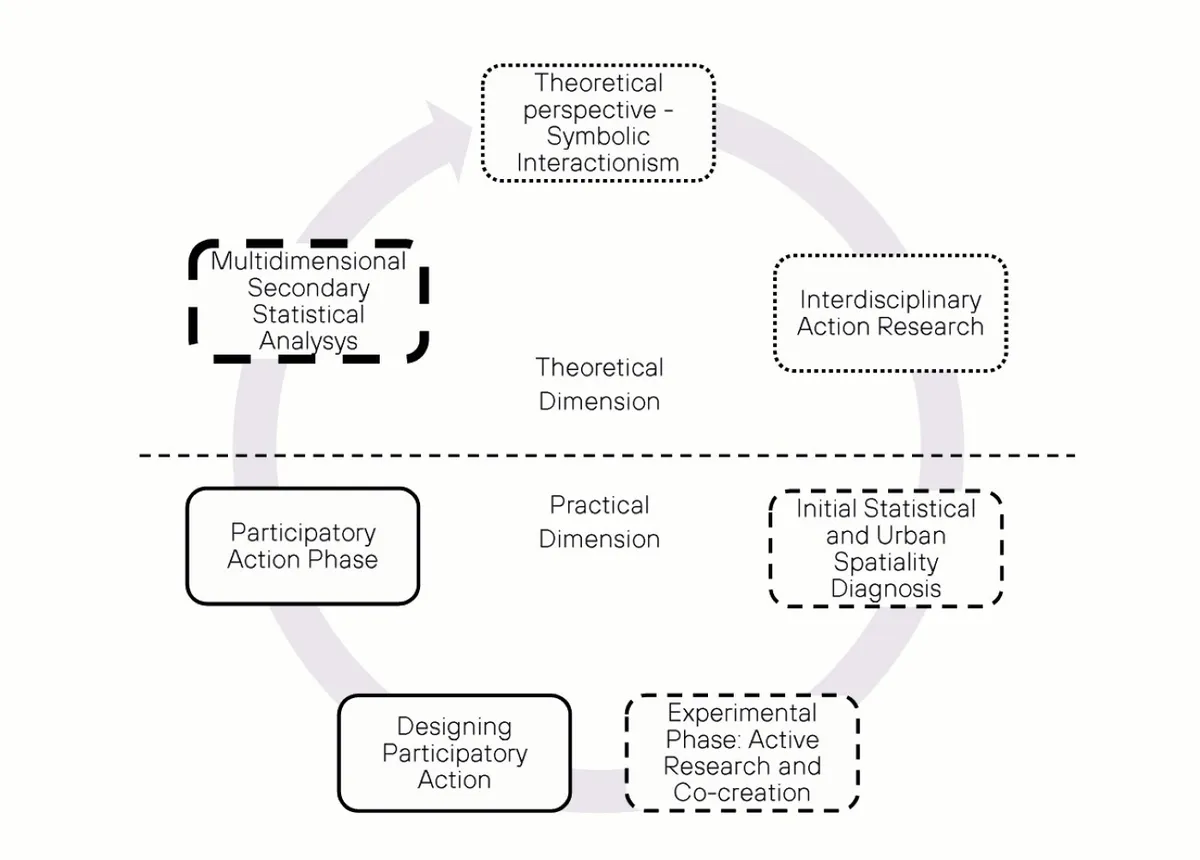
Kurt Lewin’s action research further informs the methodology through a cyclical process of planning, action, observation, and reflection, linking theory and practice to produce situated knowledge and social change (Chelcea, 2007).
This cyclical dynamic between theory and practice defines the critical participatory research, where knowledge is not merely an accumulation of information but a continuous process of learning through practice. As Erich Fromm distinguishes between “having knowledge” and “knowing” (Fromm, 2008), the model of critical action research constitutes both a reflexive exploration and a process of experiential learning.