1/3
2/3
3/3

Author(s) / Team representatives
Alexandra Ștefan
Profession
Arhitect
Text presentation of the author in English
Born in the year when "Hit Me Baby One More Time" was marking the end of the Millennium, Alexandra’s journey in the Belles Arts starts in the ancestral lands of Orăştie.
Even though technically a Gen Z, Alexandra is a Millennial at heart with her own two wolves inner battle: how to keep authentic creativeness while reconciling the social media-driven journey to success.
In love with shapes, shadows and rolled-up sleeves, Alexandra pursues the Faculty of Architecture and afterwards, back-to-back with building her own career, continues to develop her fascination for photography.
With a keen eye for the unknown and a desire to capture nature and humanity in its truest form, Alexandra approaches creativity with constant curiosity and flawless imperfection.
An Odyssey-like journey for a never-ending craving to find the fleeting beauty.
Project description in English.
The series captures a fragment of São Jorge Castle's historic walls, where the old stone, witness to centuries, remains the fixed point around which daily life unfolds — informal trade, tourism, rest in the shade, temporary works from the surrounding area. This is not about a "repaired" or "finished" building, but about the coexistence between an unmoving historic landmark and everything that happens, ever-changing, alongside it.
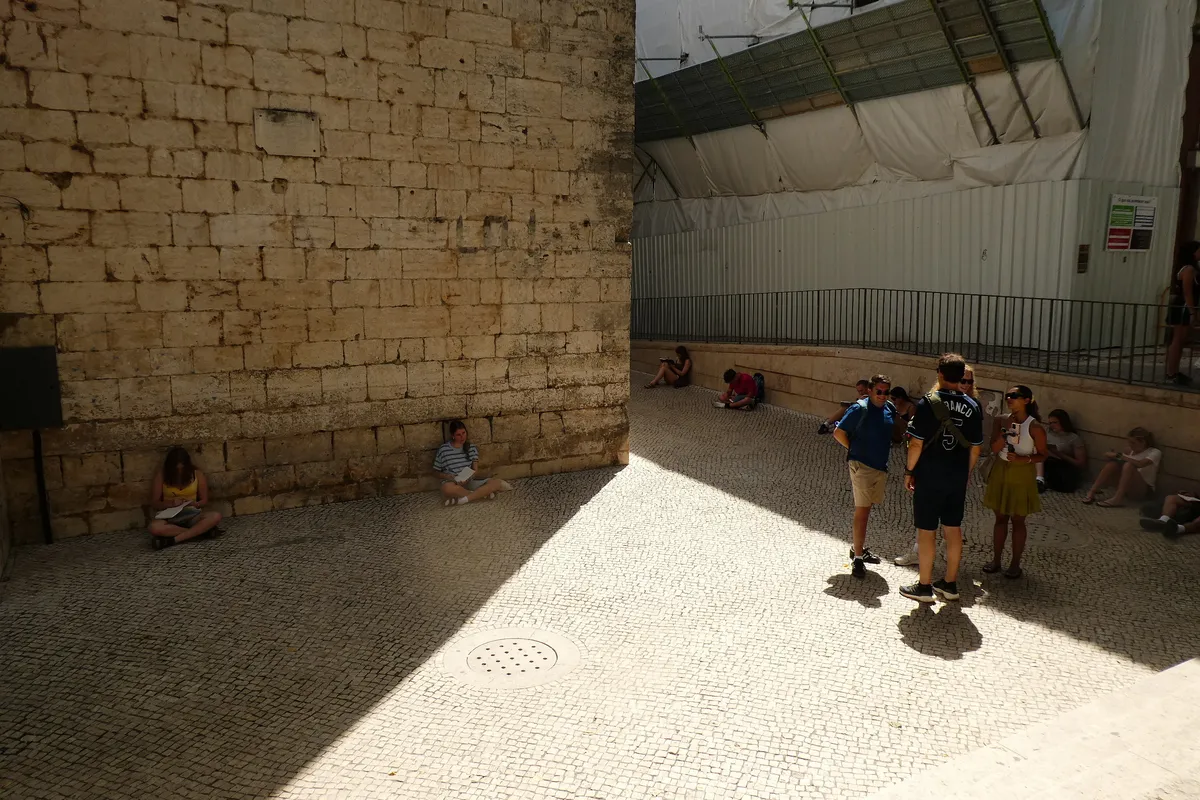
The first image fixes a moment of strong light in an inner courtyard: old stone on one side, a protective panel from a nearby construction site on the other, and in between — people. Some sit on the ground, drawing or writing, others stand talking, lit directly by the sun. The wall stays fixed, silent, while human activity moves, shifts, passes through.
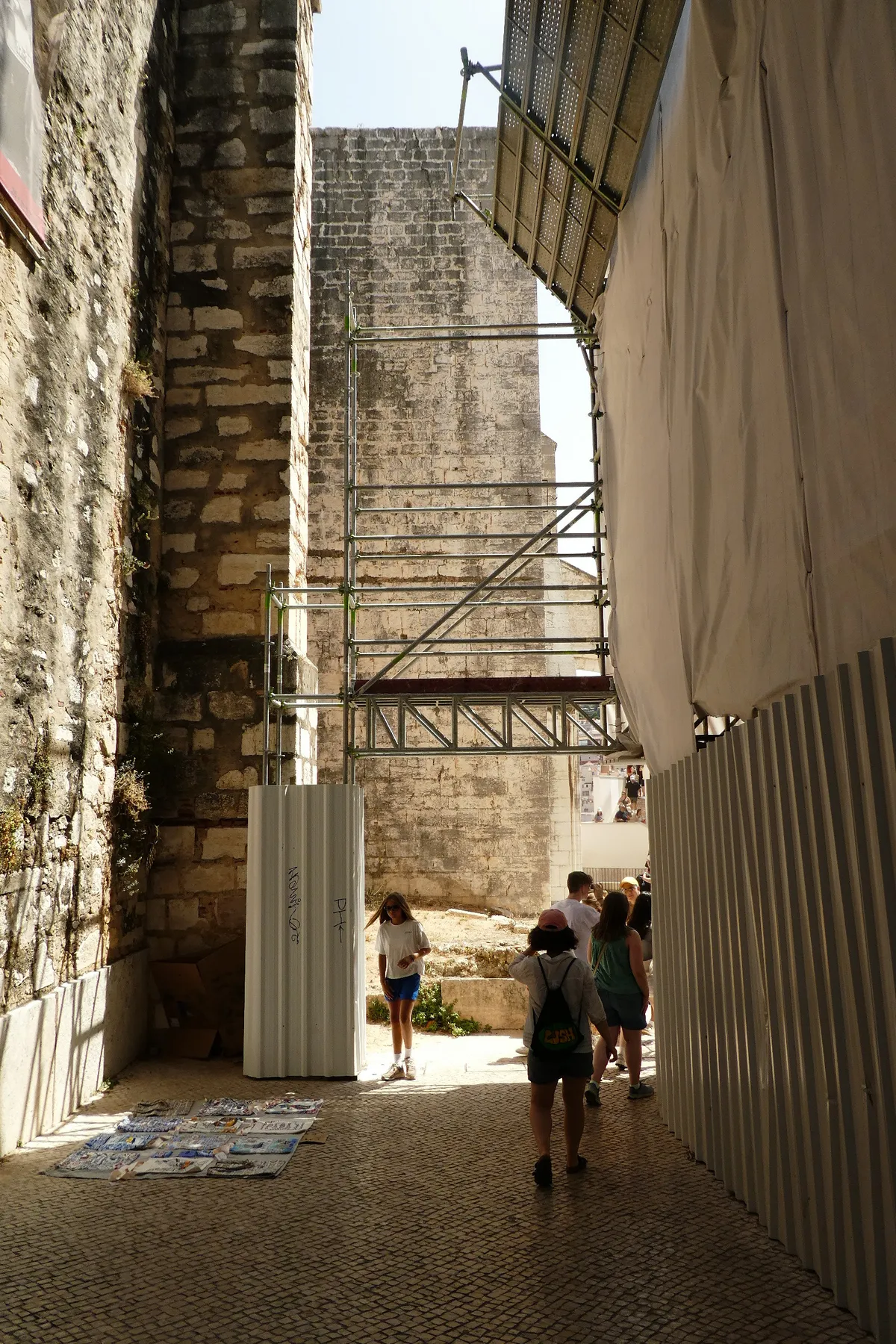
The second photograph documents a narrow corridor, bordered by the castle's old wall on one side and a temporary construction fence on the other. The visible metal scaffold belongs to work happening in the immediate vicinity, not an intervention on the historic stone itself — but its presence, right next to the monument, shows how the old and the temporary coexist within the same urban frame. Tourists pass through this space, indifferent to the boundary between the two.
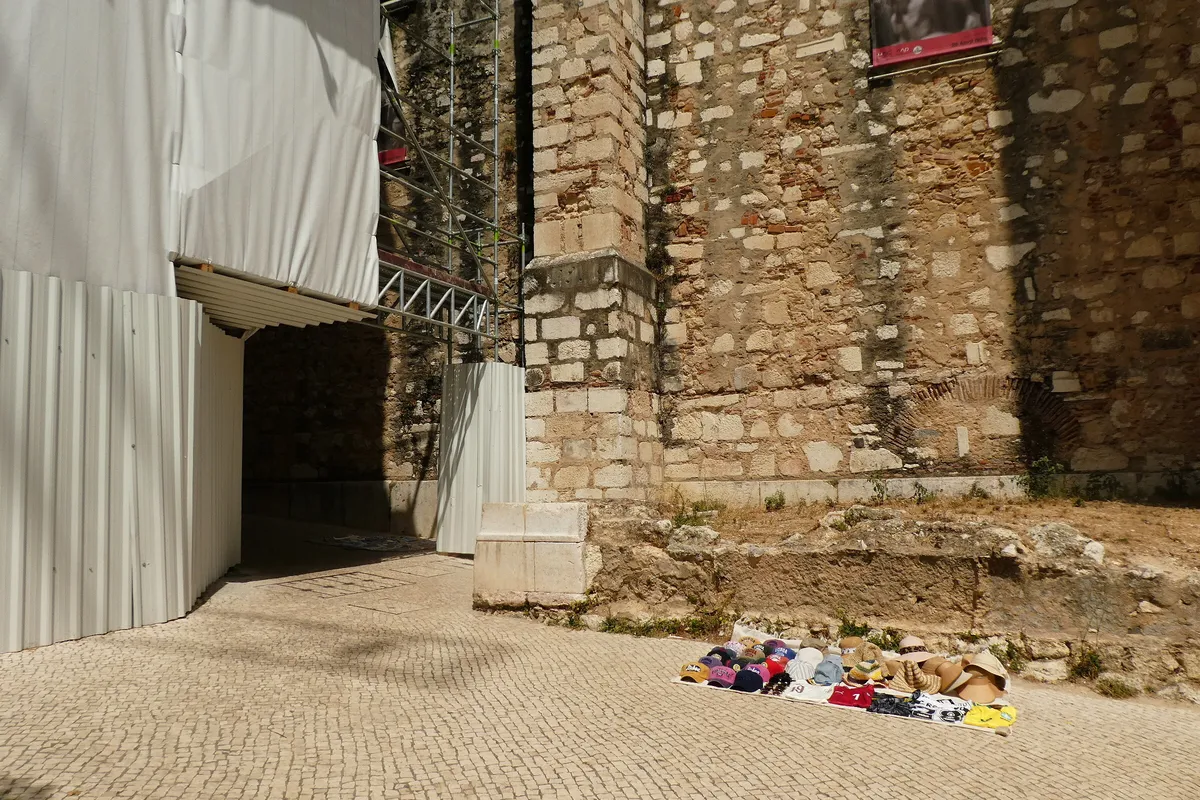
The third image captures the corner of a medieval wall, built from rough stone and brick, with masonry techniques visible from different eras. Beside it, a street vendor has laid out goods — colorful caps and hats — directly on the cobblestones, in the shade of the centuries-old structure. The historical complexity of the stone remains visible, unconcealed, while informal commerce continues naturally alongside it.
Together, the three images offer an interpretation of the theme: architecture not just as a built object, but as a constant backdrop for the life that happens around it. The old stone of São Jorge Castle remains a landmark — a stable point of reference against which everything temporary (trade, nearby construction, the passing of people) gains meaning and context. The complexity of the structure, left visible in its historical layers, is not hidden, but coexists openly with what surrounds it in the present.